
Manual Journals
Manual journals are how you post entries that don't come from a bank feed: opening balances, year-end adjustments, accruals, depreciation you're posting yourself, and corrections. Prosaic posts most entries for you from bank reconciliation, so a manual journal is the tool for everything else.
In this article
- Creating a journal
- GST and tax rates
- Importing journal lines
- Draft, posted and voided
- Editing, reversing and duplicating
- Attachments and comments
- Finding journals
- Opening balances
Creating a journal
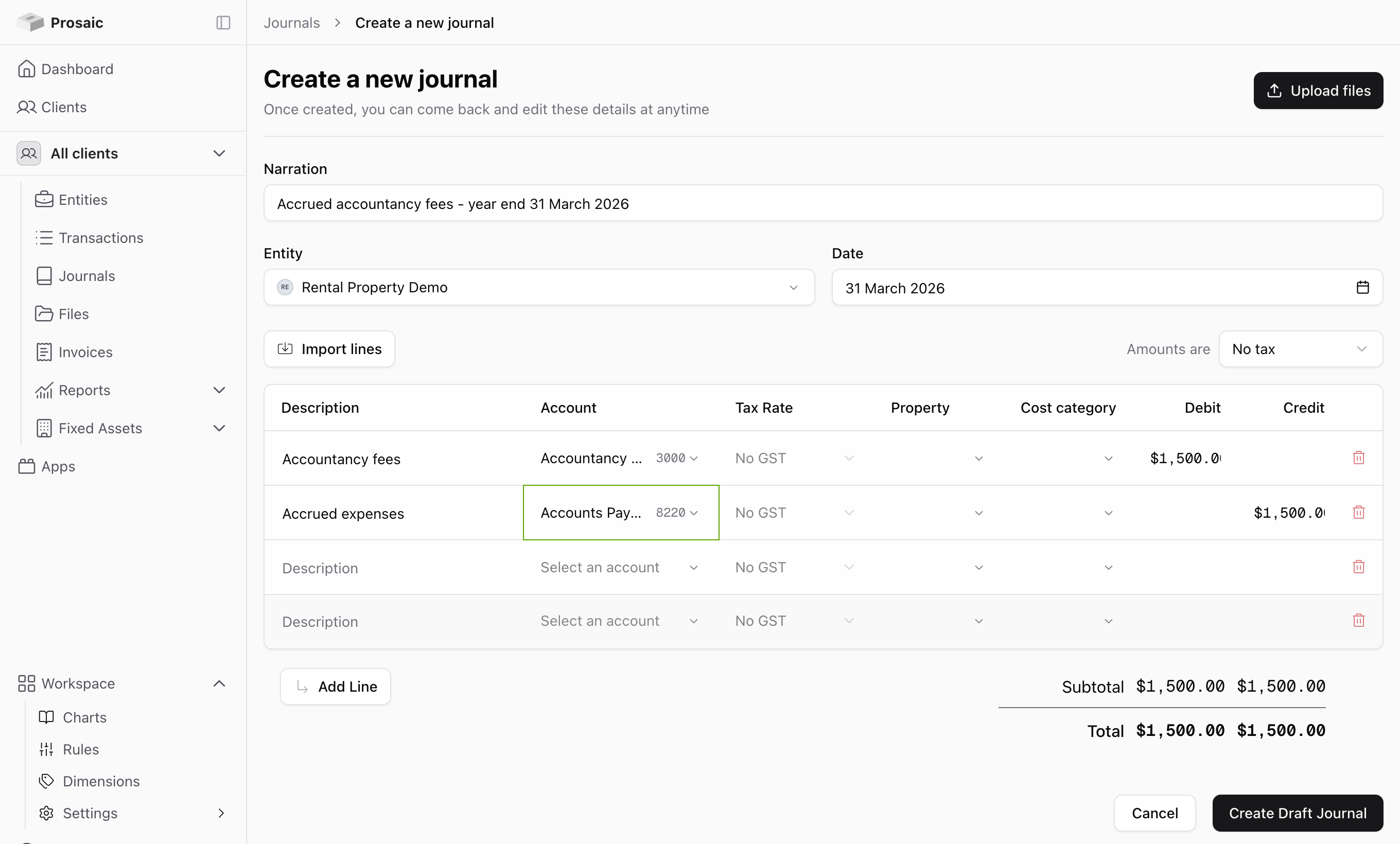
Go to Journals and select New Journal. A journal has a header and a set of lines.
In the header, write a Narration explaining what the journal is for, choose the Entity, and set the Date the entry should post on. The narration is what you and your colleagues will see in the ledger later, so it's worth writing properly.
Each line takes:
- Description for the individual line.
- Account from the entity's chart of accounts.
- Tax Rate, which defaults from the account.
- Debit or Credit.
If the entity has dimensions turned on, a column appears for each active dimension between Tax Rate and Debit.
The journal has to balance before you can post it. Prosaic subtotals debits and credits as you type, so an entry that doesn't balance is obvious before you save. Select Create Draft Journal when you're done.
GST and tax rates
Use the Amounts are selector above the lines to set the journal to No tax, Tax inclusive or Tax exclusive. This decides how Prosaic reads the amounts you enter. Year-end adjustments are usually No tax.
When a line carries a tax rate, Prosaic works out the GST and posts it to the GST account for you. You don't add a GST line yourself. The totals at the bottom show the GST and the total including GST, so you can check the entry against your source document before posting.
Take care with the tax rate on year-end adjustments. Accruals and provisions usually have no GST, and leaving a default rate in place will pull the journal into a GST return where it doesn't belong.
Importing journal lines
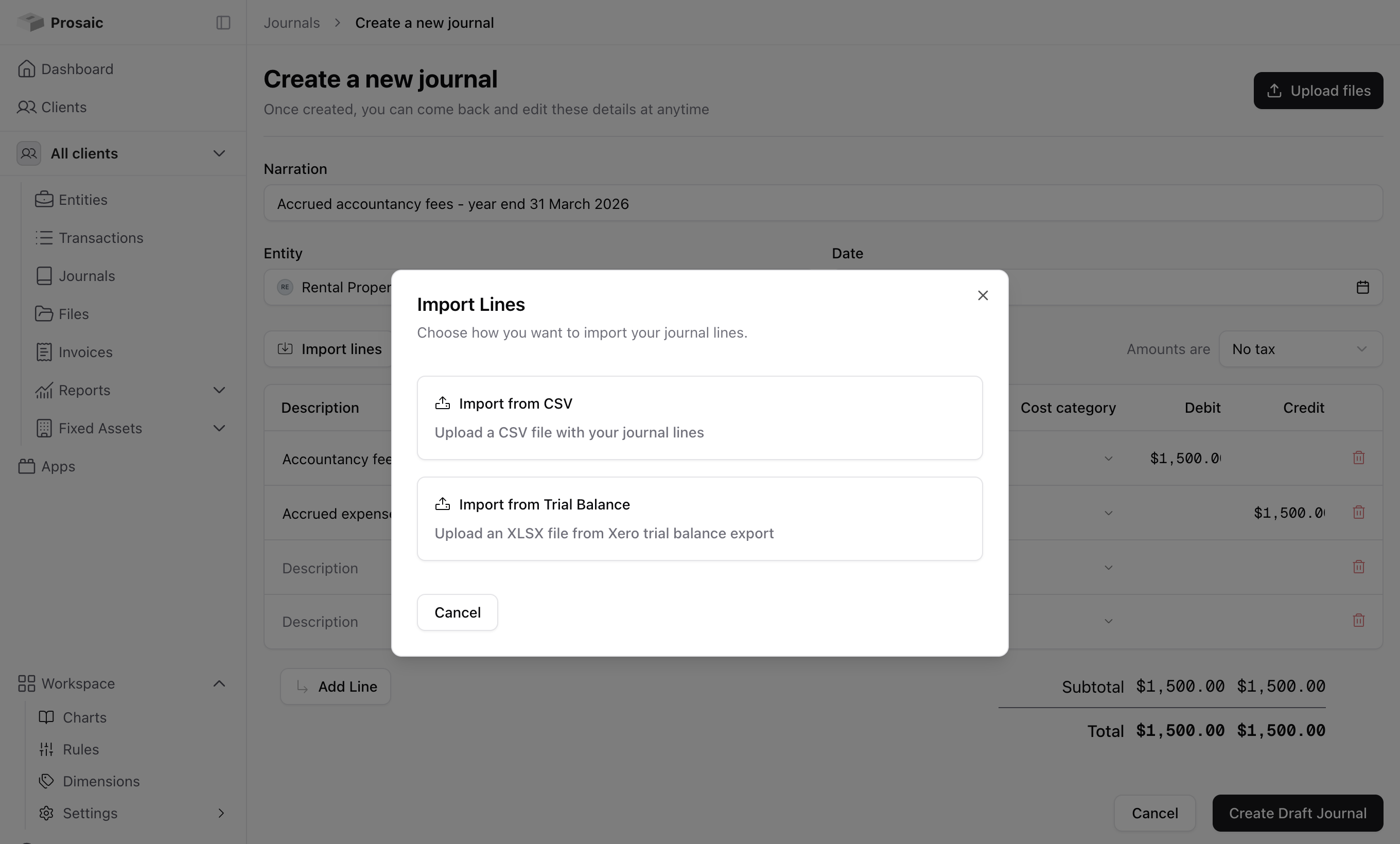
For a journal with a lot of lines, use Import lines rather than typing them. There are two ways in:
- Import from CSV, with the columns
Description,Account Code,Tax Rate,Credit,Debit. - Import from Trial Balance, using an XLSX trial balance.
Either way, Prosaic matches each row to an account by code. Tick Use mapped codes from the account template if the codes in your file are the external system's codes rather than Prosaic's, and Prosaic will match on the mapped codes in the chart template instead. That's the usual setting when you're bringing a trial balance across from another ledger.
Review the matched lines before importing. Anything Prosaic couldn't match is flagged so you can fix it.
Draft, posted and voided
A journal is in one of three states:
- Draft: saved but not in the ledger. Nothing shows in reports yet, and you can change anything.
- Posted: in the ledger and showing in reports.
- Voided: reversed out and no longer affecting the ledger, but kept on record.
Save a journal as a draft while you're still working on it. When you're happy with it, open the journal and choose Actions → Post. Voiding rather than deleting is deliberate: the entry stays visible for audit.
Editing, reversing and duplicating
A draft journal can be edited freely. A posted journal can also be edited, and Prosaic keeps a version history so you can see what the entry looked like before the change and who made it.
You can also:
- Reverse a journal, which posts an opposite entry. This is the right tool for reversing an accrual in the following period.
- Duplicate a journal, which copies it as a new draft. Useful for entries you post every month.
- Void a journal that shouldn't have been posted at all.
Attachments and comments
You can attach files to a journal, so the calculation or the source document sits with the entry rather than in a separate workpaper. Journals also carry comments, which is the place to leave a note for whoever reviews the entry, or to ask a colleague a question about it.
Finding journals
The Journals list can be filtered by entity, by status (Draft, Posted, Voided) and by source:
- Manual Journal: entries you've posted yourself.
- Bank Rec: entries Prosaic posted from reconciliation.
- Depreciation: entries from a depreciation run.
- System: entries Prosaic created, such as historical imports.
- Reversal: entries created by reversing another journal.
Filtering to Manual Journal is the quickest way to review everything your team has posted by hand in a period.
Opening balances
Opening balances are entered as a manual journal. If you're bringing an entity into Prosaic part-way through a year, post a journal dated at the conversion date with the balances from your previous system.
For the detail on how this interacts with conversion dates and statement balances, see Bank Accounts – Opening Balance, Conversion Dates and Statement Balance.
Need help?
If a journal isn't behaving the way you expect, use the 💬 button in the app or email help@prosaic.works.